
Meeting Joint Commission expectations
with your Emergency Code Carts…
The Joint Commission is an independent, nonprofit organization that accredits U.S. healthcare organizations to promote patient safety and quality of care. When it comes to code carts, The Joint Commission looks for simple but critical things: that carts are consistently stocked, properly organized, securely locked, and checked on a routine basis. Their goal is to ensure that in an emergency, staff can access the right equipment and medications immediately, without confusion, delays, or missing items.
1) Emergency meds/supplies must be available, but also secured
The Joint Commission’s core expectation is a balance: emergency medications and supplies must be readily accessible for immediate use, while also being protected from tampering, theft, or diversion.
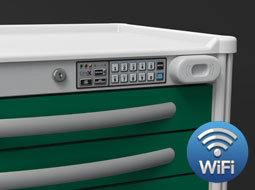
That balance is why many organizations use tamper-evident breakaway seals (often numbered/serialized). The Joint Commission states that breakaway tags with numeric identification are acceptable as long as there is a defined process to monitor seal integrity.
Important nuance: Security methods that create delays are discouraged. The Joint Commission specifically notes that devices like padlocks (or anything that creates a barrier) are discouraged and could be interpreted as making emergency supplies “not readily accessible.”
Location-based requirement: If an emergency cart containing medications is located in an area not staffed 24/7, it must be kept in a locked/secured location.
2) A risk assessment should drive your cart security approach
Rather than prescribing one “right” locking method, guidance from The Joint Commission points hospitals toward conducting a risk assessment to choose the method that best manages diversion risk without slowing emergency response.
In practice, survey readiness often hinges on whether you can show:
-
- you assessed risk (diversion/tampering vs access delays),
- you implemented controls (seals, controlled access, monitoring), and
- you have a defined process for routine checks + after-use restock/reseal.
3) Carts must be “code-ready” at all times (checks, standardization, training)
The Joint Commission safety publications highlight common failure modes seen in real events: missing/expired meds, drained batteries, empty oxygen tanks, carts that were tampered with, carts taped/padlocked in a way that delayed access, carts not checked per policy, staff unable to find the cart, and staff unfamiliar with contents or procedures.
Their “Safety Actions” emphasize the need to:
-
- start with a risk assessment (training needs, who checks, how often, equipment checks, location/access),
- ensure carts are easy to access and staff know where they are,
- standardize and clearly organize contents (including pediatric segregation/labeling where relevant),
- define who restocks meds/equipment and the exact restock process, and
- maintain a written plan covering equipment, supplies, meds, inventory management, protocols, training/competency, drills, and assignment of responsibility.
4) Crash carts/defibrillators are “high-risk equipment” and power planning matters
The Joint Commission identifies crash carts and defibrillators as high-risk medical equipment and expects a process to maintain battery charge during prolonged outages. While not mandating that battery-powered units be plugged into emergency power when on standby, it indicates that approach as a best practice and clarifies expectations around maintaining charge and emergency power use during operation.
What to look for when evaluating a new code cart (Survey Preparation Checklist)
A) Security + access (the “30-second test”)
- Tamper-evident approach that staff can open instantly (breakaway seal or equivalent) and that makes tampering obvious
- Seal-monitoring process (numbered seals logged; what triggers inspection; who replaces seals)
- If carts are outside 24/7 staffed areas: ability to store the cart in a locked location without impeding rapid response
B) Readiness / reliability
- Cart supports standardized layout (drawers/dividers/labels) so items are quick to locate and mix-ups are reduced
- Clear visibility/labeling for meds; if pediatrics applies, segregation and labeling are easy to maintain
- Compatibility with your checking method: paper checklist or electronic tracking, expiration alerts, etc. (The Joint Commission notes the benefits of systems that track cart checks and expirations)
C) Maintenance and equipment integration
- Mounting/workflow for defib, suction, O2 (and space for spare pads/batteries), and a plan for battery readiness and power during outages
D) Process fit (often what surveyors really probe)
Even the “best” cart fails a survey if the process is weak. Look for a cart that makes it easy to execute:
- Check frequency “per policy” (daily or per shift—whatever the organization defines)
- Restock ownership (pharmacy vs central supply vs nursing) and a reseal workflow
- Training/drills and staff familiarity (organization can’t rely on “it’s in the cart somewhere”)
Emergency Code Cart Compliance FAQs